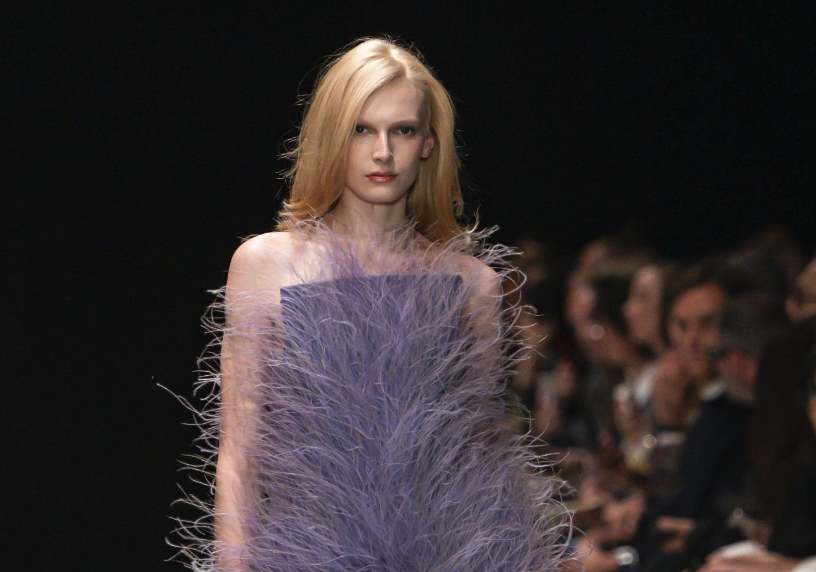
McCartney’s Spring/Summer 2026 show in Paris featured three looks trimmed in her new “fevvers” – sculptural, fluttering embellishments that read as feathers from the stalls yet are made from a plant-based material and dyed naturally. The effect was old-school glamour with a modern conscience, a neat proof-of-concept that theatre need not rely on animal parts. As the designer framed it in an interview with The Guardian, “You can still have the theatre of fashion without the animal compromise.”
Staged at the Centre Pompidou and opened by Dame Helen Mirren reading the Beatles’ Come Together, the presentation balanced activism with polish. Reporters on the day highlighted two headline innovations: fevvers, and PURE.TECH – a programmable textile designed to absorb air pollutants – within what McCartney bills as her most sustainable collection yet. The message was clear: materials are both aesthetic and ethical choices, and luxury can be both without compromise.
View the final looks from Stella McCartney’s Spring/Summer 2026 show below:
What we do – and do not – know about fevvers
McCartney has not published a full technical spec for fevvers, beyond stating that they are plant-based and naturally dyed (according to show notes and multiple outlets the whole collection was 98% sustainable and 100% cruelty-free). That caution is unsurprising at launch (proprietary processes are closely guarded at this end of the market), but the runway told us enough: the trims carry volume, hold a crisp edge and move with the lightness associated with ostrich, minus the ethical baggage. Expect more detail as prototypes move towards commercial product, but for now the takeaway is aesthetic parity with an improved provenance.
Fevvers are not a U-turn but a logical next step for a house that has never used leather, fur or skins (even for their quiet luxury bags). McCartney has been steadily substituting animal-based components with plant-derived or lab-engineered ones – most notably BioPuff, a bulrush-based insulation used in padded accessories and outerwear. The brand positions it as plastic-free and traceable from “bulrush to bag”, with wetland regeneration baked into the story. In short, the label’s “no feathers” stance now has a couture-grade alternative – and a viable one at that.
'"They're fashion’s shorthand for froth and excess. Swap them for a botanical doppelgänger and the message shifts for 2025. The spectacle stays, but the sacrifice goes."' Paris Fashion Week Editor
Why this matters for luxury now
Over coffee at a Left Bank brasserie, one editor put it crisply: feathers carry a disproportionate symbolic weight. “They’re fashion’s shorthand for froth and excess. Swap them for a botanical doppelgänger and the message shifts for 2025. The spectacle stays, but the sacrifice goes.” For buyers and editors, that widens the brief for eveningwear and stage pieces at a moment when animal welfare and tightening regulation are front of mind. As As Reuters noted, McCartney’s stance arrives as Paris continues to host houses that still use fur and feathers, making her contrast both ethical and commercial.
Will fevvers catch on?
Two things to watch. First, scale. Luxury and couture trims are a controlled environment; the test is whether fevvers can be produced consistently enough for ready-to-wear and accessories without losing finesse. Second, care and durability. Abrasion, colour-fastness and crush-recovery will determine how often these pieces appear in the wild rather than in museums. McCartney has found a way to keep the romance of plumage while retiring the bird. We hope fevvers are more than a headline – that they’re a strategic material pivot that lets eveningwear keep its poetry and lose its cruelty. If other houses follow, the most old-fashioned flourish on a gown could become fashion’s newest ethical norm.